THE STRIKINGLY BEAUTIFUL BLEND OF THE FOREST AND THE HIDDEN KARST VALLEY
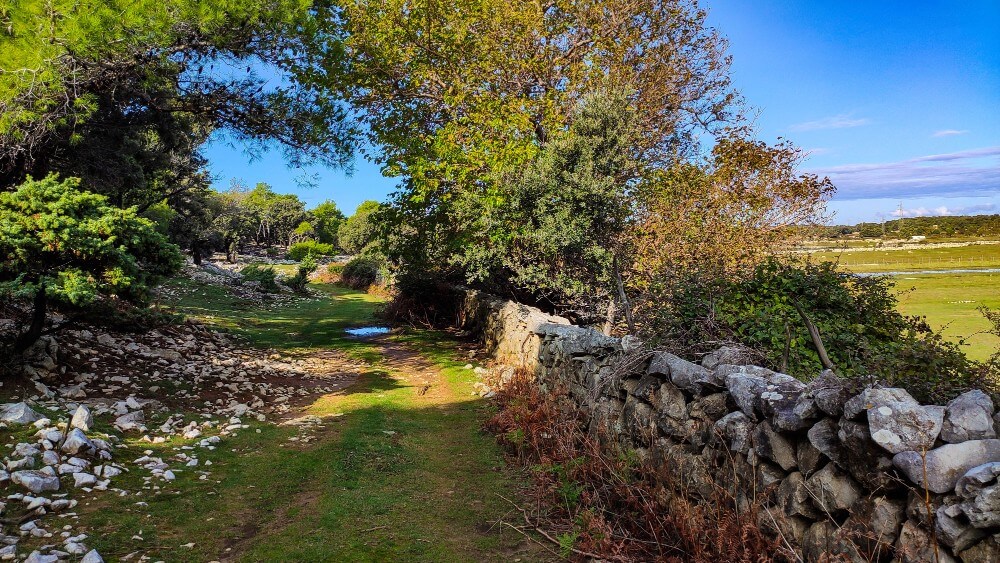
Fruga is the forest area covered by the holm oak trees and the barren forest area, with Fruška lokva, a unique karst oasis, situated in the valley, on a spacious clearing.
FRUGA REPRESENTS A PARTICULAR FORM OF DEVASTATED FOREST, BUT...
Despite the fact that the forest has been cut down and uprooted as early as the 19th century, today you will still find some beautiful old holm oak trees.
THE PERFECT SPOT FOR HIKERS AND CYCLISTS
The Frux path, connecting the bay of Supetarska Draga with Lopar, passes through this picturesque landscape with significant archaeological sites and the remains of the amazing dry stone wall construction, as well as the natural and geological phenomena, such as Fruška lokva and the fascinating soil erosion phenomena.
ŠKRAPARICA – THE LOCAL SEEDLING TERMINATOR
This local sheep breed is the native Croatian sheep breed, named Škraparica by the locals for its propensity to get between the rocks (Cro. slang: škrapa), looking for food or shelter.
RESOURCEFUL SERFS FROM FRUŠKA LOKVA
According to the lore, while picking grapes for their master, the serfs from Supetarska draga used to leave a part of it for themselves and to make wine secretly, in fear of him. They would hide wine barrels somewhere around the area of Grmine, which at that time was a dense and forested area, enjoying and secretly drinking wine.
THE AREA FULL OF LIFE
Fruška lokva is the largest waterhole on the Island, remaining completely dry in the summer. It abounds with numerous invertebrate species, such as the mayfly larvae, freshwater snails, leeches, water bugs, as well as mosquitofish and frog species.
WELL-TRODDEN PATHS
The paths used for centuries by local population and their cattle pass through the forest area, its edge and the clearing. The dry stone wall serving as a boundary around an arable land or a pasture, as well as a signpost for travellers.
THE FRUGA FOREST WAS CUT DOWN IN THE 19TH CENTURY
Although Friar Odorik Badurina wrote in the Chronicles of the Franciscan monastery in Kampor that the forest was cut down and deforested in the 1860s, there are still some parts left of the old and lush Fruga forest.
BREAD MADE FROM ACORN FLOUR
On the Island of Rab, the locals are familiar with the expression ‘acorn bread’, that is, bread made of acorn flour, as it is associated with poverty and hunger. In the Middle Ages, due to a poor yield, the common folk living on the island made acorn bread. Sometimes even bread was scarce.
The Fruga Forest
Supetarska Draga
THE STUNNING BEAUTY OF THE INSULAR AREA
The area of Fruge is located between Lopar and Supetarska Draga. It is characterised by a particular landscape criss-crossed by hiking and cycling paths. Fruga is a forest covered by holm oak trees (370 ha) and a barren forest area (620 ha), with Fruška lokva, a unique karst oasis, situated in the clearing in the valley.
FRUGA REPRESENTS A PARTICULAR FORM OF DEVASTATED FOREST, BUT…
Despite being cut down and deforested in the 19th century, one can find some beautiful old holm oak trees here even today. Friar Odorik Badurina wrote in the Chronicles of the Franciscan monastery in Kampor that the forest was cut down and deforested in the 1860s. In order to reduce the vast and devastating erosion, Pravdoje Belia, the local head forester and visuary, built embankments in this area in 1908 and the engineer Ante Premužić, the originator and designer of several fascinating paths on the island, known as the paths of Premužić (Cro. Premužićeve staze), continued his work in the period between the two world wars.
AIR FILLED WITH FRAGRANCES OF AROMATIC PLANTS
Devastated areas of the Island of Rab and the barren karst have been filled with aromatic plants and medicinal shrubs, such as sage, immortelle and thyme. Lush vegetation provides more oxygen in the air and neutralises the harmful effects of carbon dioxide and the air containing herbal and marine aerosols has got a therapeutic effect on human health.
ŠKRAPARICA – THE ARCHENEMY OF FORESTS ON THE ISLAND OF RAB
There is an animal standing in the way of the renewal and development of the forests on the Island of Rab that you will certainly come across. It is the native local sheep breed named škraparica grazing on the seedlings. The sheep from the Island of Rab is the Croatian native breed named škraparica by the locals for its propensity to get between the rocks (Cro. slang: škrapa), looking for food or shelter. Therefore, it is small in stature, but of a harmonious and strong body type. Today, it is predominantly kept for the production of meat, such as lamb. Only a small number of sheep is kept for the purpose of milk production.
THE HARD LIFE OF FARMERS
At the end of the 19th century and the beginning of the 20th century, the male population of Supetarska Draga would arrive in this area in the spring and live in their stone huts. The shepherds’ stone huts are dry stone buildings in which people and their cattle occasionally resided. In addition to sheep which they milked, they had here all they needed for life. Women would come occasionally and men would go to the village only on Sundays to go to church.
HARD-WORKING ANCESTORS
The Fruga Valley which lies adjacent to the forest bearing the same name was a cultivated area in the past, representing the granary of this part of the island. Locals were plowing, cultivating and sowing corn, wheat, barley and rye and not a single piece of land remained uncultivated, as on the smallest plots broad beans and chickpeas were planted. The inhabitants of Lopara, Draga and Mundanije would transport grain on donkeys to Mlinica, a unique watermill located at the waterfront. There were two more watermills close to the Church of St. Peter (Cro. Crkva Sv. Petra) in Supetarska Draga on the creek named Veli potok.